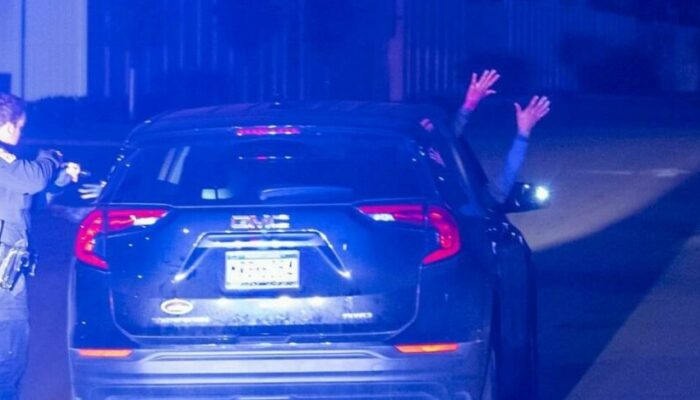
Almost everyone who has been pulled over in California has had the same experience. The lights come on, the officer walks up, and the first words out of their mouth are a question. Where are you coming from. Do you know why I stopped you. Is there anything in the car I should know about.
Since the beginning of 2024, that opening is backwards under California law. Here is what the statute actually requires, what it does not do, and why the answer an officer gives at your window can matter a great deal later.
QUICK ANSWER: Since January 1, 2024, California Vehicle Code section 2806.5 requires an officer to state the reason for a traffic or pedestrian stop before asking any questions, and to document that reason on the citation or report. The only exception is a reasonable belief that withholding it is necessary to protect life or property from an imminent threat. The statute sets a duty on the officer, not an automatic remedy for you.
What the law says
AB 2773 took effect on January 1, 2024. It added section 2806.5 to the Vehicle Code and it does two things.
First, an officer making a traffic or pedestrian stop must state the reason for the stop before asking any question related to a criminal investigation or a traffic violation.
Second, the officer must document that stated reason on any citation issued and in any report resulting from the stop.
There is one exception. An officer may withhold the reason if they reasonably believe that withholding it is necessary to protect life or property from an imminent threat, and the statute gives terrorism and kidnapping as the kind of circumstances contemplated. That is a narrow carve out, not a general escape hatch for an officer who would rather ask questions first.
The same legislation also requires agencies to report the stated reason for each stop to the California Department of Justice as part of the data collected under the Racial and Identity Profiling Act, found at Government Code section 12525.5.
What a “pretextual stop” actually means
A pretextual stop is a stop where the officer uses a minor, technically valid reason as the entry point for an investigation into something else entirely. A cracked taillight becomes a conversation about where you are going. A slow roll at a stop sign becomes a request to search the trunk.
Under federal law, the Supreme Court held in Whren v. United States (1996) that an officer’s actual motive does not invalidate a stop that is objectively supported by probable cause of a traffic violation. That remains the constitutional baseline, and it is why “he only pulled me over because of how I look” is difficult to litigate as a Fourth Amendment claim standing alone.
Vehicle Code section 2806.5 does not overrule Whren. What it does is create a paper record. The officer has to say a reason out loud, at the roadside, before hearing anything from you. Then they have to write that same reason down. Then the agency has to report it to the state.
Why the paper record matters
Cases involving traffic stops usually turn on a mismatch, and the mismatch is easier to find now.
- The stated reason and the written reason are different. An officer who says “you were weaving” at the window and writes “expired registration” in the report has a problem, and so does the credibility of everything else in that report.
- The stated reason does not match the video. Body camera and dash camera footage captures the first words spoken. If the officer began with questions instead of a reason, that is on the recording. Our guide on how to get the body camera video of your arrest covers how to request it.
- The stated reason does not appear anywhere. No reason on the citation, no reason in the report, no reason on the video. In a case that later involves a search, an arrest, or a resisting charge, that absence is worth a great deal.
- The pattern is documented. Because agencies now report stated reasons to the Attorney General, one person’s questionable stop can be placed against the department’s own stop data. That is how an individual complaint becomes evidence of a practice.
What the statute does not do
This is where honest expectations matter.
Section 2806.5 does not say that evidence gets suppressed if an officer skips the required statement. It does not create a right to sue for money damages by itself. It does not make a stop unlawful that was otherwise supported by reasonable suspicion or probable cause. And it does not give you the right to refuse to identify yourself or to drive away.
What it does is give you and your lawyer a concrete, statutory expectation that the officer’s own conduct can be measured against. In practice it functions less like a shield at the roadside and more like a lever afterward, in a criminal defense motion, in a civil rights case, or in a complaint to the agency.
What to do at the stop itself
The roadside is not the place to litigate. It is the place to stay safe and preserve the record.
- Pull over promptly, stay in the car, keep your hands visible, and turn on the interior light at night.
- You may ask, calmly and once, “Officer, what is the reason for the stop?” Asking is not resisting.
- You are required to provide your license, registration, and proof of insurance when driving.
- You do not have to answer investigative questions. You can say that you prefer not to answer questions and would like to go on your way.
- You do not have to consent to a search. Saying “I do not consent to a search” clearly and once is not obstruction. Physically interfering would be.
- Do not argue about whether the stop was legal. That argument is won later, in a courtroom, with the footage.
Refusing consent or declining to answer is not, by itself, a lawful basis for an arrest. When an officer responds to a polite refusal by escalating, that escalation frequently produces a charge under Penal Code section 148 or section 69. Our article on passive versus active resistance explains where courts have drawn that line.
When a stop turns into something worse
Many of the cases this firm handles started as a routine stop. Someone asked a question, or did not move fast enough, or reached for a phone to record, and within a minute they were on the pavement facing charges for resisting an officer.
If that happened to you, write down everything you remember while it is fresh, photograph any injuries the same day and again as bruising develops, get medical care, and preserve any video you or your passengers took. Then act quickly, because a claim against a California city, county, or state agency generally requires a written government claim within six months.
Frequently asked questions
Yes. Vehicle Code section 2806.5 requires the officer to state the reason for the stop before asking questions, unless withholding it is reasonably necessary to protect life or property from an imminent threat.
January 1, 2024. It was enacted by AB 2773.
The statute does not provide an automatic remedy. The failure is evidence, and it can matter in a suppression motion, a civil rights case, or an administrative complaint, but it does not by itself void the stop.
A stop supported by an objectively valid traffic violation is generally lawful even if the officer had another motive, under Whren v. United States. Section 2806.5 regulates how the stop begins rather than prohibiting pretext.
No. You must provide license, registration, and insurance when driving. You are not required to answer investigative questions.
Declining consent is not a crime and is not, standing alone, a lawful basis for arrest. If you were arrested after refusing, that sequence is worth reviewing with a lawyer.
Agencies report stop information, including the stated reason, to the California Department of Justice under the Racial and Identity Profiling Act, Government Code section 12525.5.
Yes. The statute covers pedestrian stops as well as vehicle stops.
If a traffic stop in Southern California ended in an arrest you believe was unlawful, the Law Office of Jerry L. Steering handles false arrest and false imprisonment cases. You can reach the Newport Beach office at (949) 474-1849.
About the Author
Jerry L. Steering has represented people injured or falsely arrested by law enforcement since 1984. He graduated from the University of Georgia School of Law in 1984 and has been licensed in California since 1986 (State Bar No. 122509). His Newport Beach practice covers police misconduct, civil rights, and criminal defense throughout Orange, Los Angeles, Riverside, San Bernardino, San Diego, Ventura, Santa Barbara, and Kern counties.
This article is general legal information, not legal advice about your situation. Reading it does not create an attorney client relationship.
Sources
- California Vehicle Code section 2806.5, added by AB 2773 (2021 to 2022 Regular Session), effective January 1, 2024
- California Government Code section 12525.5 (Racial and Identity Profiling Act reporting)
- Liebert Cassidy Whitmore, “AB 2773 Imposes Procedural Requirements For Police Stops”
- Criminal Legal News, “California AB 2773 Requires Police to State Reason for Traffic Stops Before Questioning,” May 2024
- Whren v. United States, 517 U.S. 806 (1996)
- California Penal Code sections 148 and 69
- California Government Code section 911.2

Steering Law is a California-based civil rights and criminal defense firm led by Jerry L. Steering, Esq. The firm focuses on police misconduct cases, including excessive force, false arrest, malicious prosecution, contempt of cop incidents, and 42 U.S.C. §1983 civil rights actions, while also handling serious criminal defense matters. Steering Law is dedicated to protecting clients’ constitutional rights and delivering justice for individuals who have been wronged by law enforcement.
