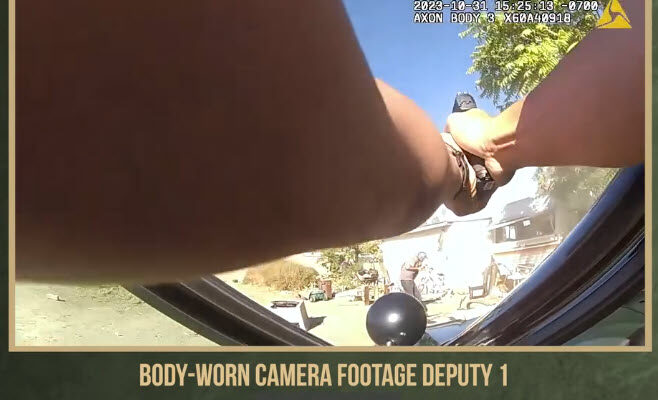
No, not if the person no longer poses an immediate threat. Courts judge police force by what was reasonable at each moment, not just at the start. If a person has been wounded, has fallen, and is not attacking or trying to get up, later shots can be unconstitutional. In June 2025, the full Ninth Circuit held that a jury could find an LAPD officer’s last two shots, fired after the man had fallen, were unlawful. The Supreme Court declined to review that ruling in June 2026. California’s deadly force law, Penal Code 835a, is also stricter than the federal rule.
Key points:
- Force that was justified at the start can become excessive once the threat ends.
- When the danger is over, the shooting must stop.
- California law is stricter than the federal minimum.
- The number of shots alone is not the test. The timing between shots matters.
- Video and physical evidence usually decide these cases.
- You generally have only six months to file a government claim.
- Survivors and families can sue for civil rights violations.
In every police shooting case we handle, the story comes down to seconds. Officers say it all happened too fast to think. That can be true for the first shot. It is rarely true for the last one.
The law says what common sense always has: when the danger ends, the shooting has to end too. This guide explains how courts decide that, why officers often fire so many times, what rights you have if you were shot by police, and what to do next.
Quick Answer
Not necessarily. Under Ninth Circuit law, force that was justified at the start of an encounter can become excessive once the threat ends. In June 2025, the full Ninth Circuit held a jury could find that an LAPD officer’s final two shots, fired after the man had fallen, were unconstitutional. The Supreme Court declined to disturb that ruling in June 2026.
Can police keep shooting someone who is already down?
Not if the person no longer poses an immediate threat. The Ninth Circuit holds that officers must reassess as an encounter unfolds. Force that was reasonable a moment earlier can become excessive once a suspect is wounded, on the ground, and not trying to get up or attack. A jury can decide whether the later shots crossed that line.
The constitutional test comes from Graham v. Connor (1989): was the force “objectively reasonable” under the circumstances the officer faced? The key word is circumstances, plural. They change. A man charging with a knife is one circumstance. The same man curled on the pavement after being shot four times is another.
California’s own deadly force statute points the same direction. Since 2020, Penal Code 835a has allowed an officer to use deadly force only when necessary to defend against an imminent threat of death or serious bodily injury. Once the threat is gone, the justification is gone with it.
When Is a Police Shooting Legal? The Rules Officers Must Follow
Deadly force is legal only when an officer reasonably believes there is an immediate threat of death or serious injury to the officer or someone else. Everything else, including the number of shots, is judged against that rule.
The Federal Test: Graham v. Connor
The Supreme Court set the basic rule in Graham v. Connor: was the force “objectively reasonable” under the circumstances the officer faced?
What “Objectively Reasonable” Means
Courts ask what a reasonable officer would have done in that same situation, without hindsight. The key word is circumstances. A man charging with a knife is one situation. That same man lying on the pavement after being shot is another. Circumstances change second by second, and the law expects the officer to notice.
Shooting a Fleeing Suspect: Tennessee v. Garner
In Tennessee v. Garner, the Supreme Court ruled that police cannot use deadly force on a fleeing suspect who poses no significant danger. Running away is not enough. The officer needs a reasonable belief that the person threatens death or serious harm.
California’s Stricter Rule: Penal Code 835a
Since 2020, California Penal Code 835a has allowed deadly force only when it is necessary to defend against an imminent threat of death or serious bodily injury. Once the threat is gone, the legal reason for deadly force is gone with it.
Federal vs. California Deadly Force Standard
| Question | Federal (Fourth Amendment) | California |
| Basic standard | Objectively reasonable force | Deadly force only when necessary |
| What courts look at | Totality of the circumstances | Totality of the circumstances, with a necessity requirement |
| Fleeing suspect | Allowed only if a significant threat | Same, and the force must still be necessary |
| Who decides | Often a jury | Often a jury |
Why Do Police Shoot So Many Times? (And Why It Doesn’t Make It Legal)
Most families ask us the same thing: why so many shots? The honest answer is training, stress, and human limits. But none of these explanations makes extra shots legal when the threat has ended.
“Trained to Shoot Until the Threat Stops”
Officers are generally trained to keep firing until the threat is neutralized and not to pause in the middle. According to CNN’s reporting, experts say stopping to assess could give a suspect time to hurt someone. That training is why officers say they “kept firing.” The problem arises when the threat has already ended and the officer keeps going.
Stress, Sympathetic Fire, and Reaction Time
Several things push shot counts up:
- Sympathetic fire. When one officer fires, others may fire too, even if they have not seen a threat themselves.
- Stress and memory. Officers in high-stress shootings often cannot say how many shots they fired. Some report a few shots when the real number was much higher.
- Missed shots. A 2019 Dallas study found officers hit their targets only about 35% of the time, so more rounds go out.
- Reaction time. Police trainers point to perception-reaction time, generally 0.7 to 1.5 seconds. In a Force Science Institute test of 102 officers, the slowest fired six more trigger pulls after a signal to stop.
What evidence decides a police shooting case?
Video, timing, and physical evidence. These cases turn on what happened between each shot: where the person was, which way he was moving, and whether he was still a threat. Body camera and dash camera footage, the autopsy or medical records, the location of shell casings, and witness accounts usually decide whether a jury hears the case.
In Hernandez, the video showed the timing of each shot. In Zion, the dashcam contradicted the deputy’s testimony that the man was trying to get up. Officers’ reports are written after the fact, often after they have watched the footage. The footage itself does not change its story.
If your family is dealing with a police shooting, these are the first steps:
- Preserve every piece of evidence you have, including phone video, texts, and photos.
- Identify witnesses and cameras in the area quickly, before footage is overwritten.
- Request the video. California law generally requires agencies to release critical incident video within 45 days, with limited exceptions. I explain the process in How to Get the Body Camera Footage of Your Arrest in California.
- Mind the six-month deadline for a government claim against the city or county.
- Talk to a civil rights attorney before giving any statement to investigators.
If a loved one died, there are often two kinds of claims, which I explain in What’s the Difference Between a Wrongful Death and an Excessive Force Claim After a Police Shooting?
What the Defense Will Argue, and Why It Doesn’t End the Case
Expect the city or county to say the officer simply could not stop fast enough. It is a real argument, and we take it seriously. But it has limits. In the Hernandez case, the officer fired six shots in about six seconds, and the court still held that a jury could decide the last two were unlawful. The question is not whether the officer is human. The question is whether the force was reasonable at that moment.
Common Police Explanation vs. How It Holds Up
| Explanation | What it means | How we challenge it |
| “It all happened fast.” | Officer had no time to think | Frame-by-frame video shows when each shot was fired and what the person was doing |
| “I wasn’t counting my shots.” | Officer can’t recall the number | Body cam, audio, and casing locations show the real count |
| “Other officers were firing.” | Sympathetic fire | Each officer is responsible for their own force |
| “I couldn’t stop in time.” | Reaction-time delay | Courts still ask if the later shots were reasonable and let juries decide |
Court Rulings That Changed Police Shooting Law
A few decisions now shape every police shooting case in California.
Estate of Hernandez v. City of Los Angeles (Ninth Circuit, 2025)
In 2020, after a multi-car crash in Los Angeles, Daniel Hernandez got out holding a box cutter and moved toward an officer. She fired six shots in roughly six seconds. The full Ninth Circuit found the first four shots reasonable. But it held that a jury could find the last two, fired after he had fallen and was rolling away, were unconstitutional. The court denied the officer qualified immunity on those shots. On June 22, 2026, the Supreme Court declined to hear the city’s appeal, and the case returns to the trial court.
Zion v. County of Orange (2017)
In Zion, a deputy kept shooting a man who had collapsed and then stomped on his head. The Ninth Circuit held that a jury could find that was excessive force. That decision put California officers on notice, and the Hernandez court relied on it. We wrote about it when it came down: a deputy can be sued for shooting a suspect and then stomping on his head.
Barnes v. Felix (U.S. Supreme Court, 2025)
In 2025, the Supreme Court unanimously rejected the “moment of threat” rule, which looked only at the split second an officer felt afraid. Courts must now weigh the whole situation, including events leading up to the shooting. That helps victims, because an officer’s earlier choices count too.
Why Qualified Immunity Matters
Qualified immunity protects officers unless an earlier case clearly told them their conduct was unlawful. It is a major hurdle in these lawsuits. Decisions like Zion help clear it. California also gives victims other tools, which we explain in qualified immunity vs. the Bane Act.
Shot by Police? Your Rights as a Victim
If you or a family member were shot by police, you are not powerless. You have several ways to review what happened and to hold officers accountable.
Your Right to Request Video and Records
California law generally requires agencies to release video of critical incidents, including shootings, within about 45 days, with limited exceptions. You can also ask for reports and other records. Our guide explains how to get the body camera footage of your arrest. Your attorney can also use the legal process to demand records that police refuse to hand over.
Your Right to File a Complaint
You can file a complaint with the police department, and it will be investigated internally. But an internal review is not a lawsuit. It rarely brings compensation, and the department is judging itself. Many victims do both: file the complaint and pursue a civil case.
Your Right to Sue for Civil Rights Violations
You can sue for civil rights violations in state or federal court. Common claims include:
- Excessive force under the Fourth Amendment, brought through 42 U.S.C. § 1983
- Violations of California’s Bane Act
- Wrongful death, if the person died
- Claims against the city or county, not only the officer
Types of Police Brutality Cases Involving Shootings
Police brutality cases come in many forms. These are the shooting-related situations we see most:
- Shot while surrendering or with hands raised
- Shot in the back while turning or moving away
- Unarmed person shot
- Additional shots after the person is already down
- Shooting during a welfare check or mental health crisis
- Shooting after the officer created the danger
- Fatal shootings that lead to wrongful death claims
The legal path can differ depending on whether the person survived. We explain the difference in wrongful death vs. excessive force claims after a police shooting.
What to Do After a Police Shooting: Step-by-Step
The first days matter more than most people realize. Evidence disappears quickly.
- Get medical care and keep every record. Hospital notes, bills, and photos of injuries are evidence.
- Save all video, photos, and messages. Phone footage, texts, and social posts can matter.
- Find witnesses and cameras fast. Businesses and doorbell cameras often overwrite footage within days.
- Request the official video and reports. Do this early, and keep copies.
- Do not give a statement to investigators yet. Talk to a civil rights attorney first.
- Watch the government claim deadline. This is the one people miss. Read about the six-month government claim deadline.
Key Deadlines
| Step | Typical deadline | Note |
| Government claim against a city or county | 6 months | Generally required before suing |
| Civil rights lawsuit | Generally 2 years | Can differ by claim type |
| Request body camera video | Agencies generally release within about 45 days | Limited exceptions apply |
Deadlines vary by case. Speak to an attorney as soon as you can.
What Evidence Wins a Police Shooting Case?
These cases usually turn on what happened between each shot. The strongest evidence includes:
- Body camera and dash camera footage
- The timing of each shot
- Medical records or the autopsy
- The location of shell casings
- Independent witness accounts
- Officer reports compared against the video
Reports are often written after officers have watched the footage. The footage itself does not change. In Zion, the dashcam contradicted the deputy’s claim that the man was trying to get up.
Can You Win Compensation After a Police Shooting?
Many survivors and families recover compensation, but every case is different. Possible damages include medical bills, lost income, pain and suffering, and, in wrongful death cases, losses suffered by the family. Punitive damages may be available in some cases.
Our firm obtained $2.9 million for a motorist shot by Anaheim police. Past results do not guarantee future outcomes.
Why Choose Steering Law for a Police Shooting Case
Steering Law has represented people hurt by police since 1984. Jerry L. Steering has spent four decades suing police departments and defending people charged after police force. We represent people shot by police, and families of those killed, across Southern California, including Orange, Los Angeles, Riverside, San Bernardino, and San Diego counties.
We know how these cases are won: early evidence, frame-by-frame video review, and a clear understanding of qualified immunity. If you need a police shooting attorney, call Steering Law at (949) 474-1849 for a consultation.
Bottom Line
The law does not let an officer keep shooting once the threat is over. Courts look at each moment, California’s rule is stricter than the federal one, and video and timing usually decide the case. Deadlines are short, so waiting can cost you your claim. If you or someone you love was shot by police, talk to Steering Law at (949) 474-1849 before you speak to investigators
Frequently Asked Questions
Not if the person no longer poses an immediate threat. A person who is wounded, down, and not attacking can no longer justify deadly force. A jury can decide whether later shots crossed that line.
Sometimes, but only if the person still posed an immediate threat. Officers sometimes argue the person turned during the shooting. Video and timing usually show whether the threat had ended when the shot was fired.
Generally not. Under Tennessee v. Garner, police cannot shoot a fleeing person who poses no significant danger. The officer must reasonably believe the person threatens death or serious injury.
Police are trained to aim at the largest part of the body. Experts quoted by FRONTLINE say hitting a leg under stress is unrealistic, a leg wound can still be fatal, and missed shots can hit bystanders. That does not excuse unlawful force.
Often yes. A resisting charge does not automatically block a civil rights case, though it can complicate it. Speak to an attorney before taking a plea.
You generally have six months to file a government claim, and about two years to file a lawsuit. Deadlines can vary, so act quickly.
Legal Disclaimer
Disclaimer: This article is for general informational purposes only and does not constitute legal advice. Reading this post or contacting Steering Law through this website does not create an attorney-client relationship. Every case is different; if you are facing a legal issue, you should consult a qualified California attorney about your specific situation. Past results do not guarantee similar outcomes.
Sources
- Estate of Hernandez v. City of Los Angeles, Nos. 21-55994, 21-55995 (9th Cir. June 2, 2025) (en banc): https://cdn.ca9.uscourts.gov/datastore/opinions/2025/06/02/21-55994.pdf
- Officer.com, “Supreme Court Says Former Los Angeles Police Officer May be Sued for Excessive Force in Shooting,” June 23, 2026: https://www.officer.com/command-hq/news/55386028/supreme-court-says-former-los-angeles-police-officer-may-be-sued-for-excessive-force-in-shooting
- Zion v. County of Orange, 874 F.3d 1072 (9th Cir. 2017) (Courthouse News coverage): https://www.courthousenews.com/9th-circuit-revives-suit-oc-police-killing/
- Barnes v. Felix, 605 U.S. ___ (2025) (Cornell LII): https://www.law.cornell.edu/supremecourt/text/23-1239
- Graham v. Connor, 490 U.S. 386 (1989) (Justia): https://supreme.justia.com/cases/federal/us/490/386/
- California Penal Code section 835a (California Legislative Information): https://leginfo.legislature.ca.gov/faces/codes_displaySection.xhtml?lawCode=PEN§ionNum=835a

Steering Law is a California-based civil rights and criminal defense firm led by Jerry L. Steering, Esq. The firm focuses on police misconduct cases, including excessive force, false arrest, malicious prosecution, contempt of cop incidents, and 42 U.S.C. §1983 civil rights actions, while also handling serious criminal defense matters. Steering Law is dedicated to protecting clients’ constitutional rights and delivering justice for individuals who have been wronged by law enforcement.