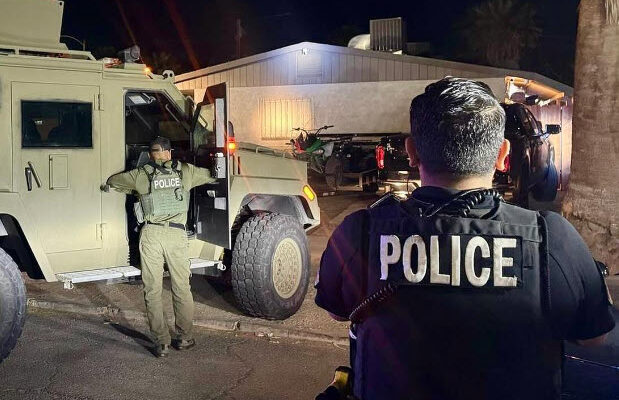
Most families in this situation made the call themselves.
Someone was in crisis, or off their medication, or talking about hurting themselves, and the family did what they were told to do. They called for help. What arrived was armed. Minutes later someone they love was injured, or gone.
If that is your family, the guilt you are carrying is not yours to carry. You asked for help for a person in medical distress. What happened next was a set of choices made by people who are trained, paid, and equipped to make them differently.
This article explains what California law actually allows in these cases. It is general information, not advice about your situation.
QUICK ANSWER: Yes, a family can bring a case. Three theories usually apply together in California: a Fourth Amendment excessive force claim under 42 U.S.C. section 1983, a state negligence claim that reaches the officers’ tactics before force was used, and a claim under Title II of the Americans with Disabilities Act for failing to reasonably accommodate a known disability. A written government claim is generally due within six months.
Three claims that work together
The federal excessive force claim
Under 42 U.S.C. section 1983, force by an officer is judged against the Fourth Amendment’s objective reasonableness standard from Graham v. Connor (1989). Courts weigh the severity of the offense, whether the person posed an immediate threat, and whether they were actively resisting or fleeing.
An important change arrived recently. In Barnes v. Felix, 145 S. Ct. 1353 (2025), a unanimous Supreme Court rejected the “moment of threat” approach, under which some courts looked only at the final seconds before force was used. The Court held that reasonableness is judged on the totality of the circumstances, which includes what led up to the encounter.
For crisis cases that holding matters enormously, because so much of what goes wrong happens in the minutes before anyone is touched.
The California negligence claim
California law has been ahead of federal law on this point for years. In Hayes v. County of San Diego (2013) 57 Cal.4th 622, the California Supreme Court held that an officer’s pre-shooting tactical conduct and decisions are part of the totality of circumstances a jury may consider in a negligence claim.
Put plainly: under California law a jury can be asked whether it was reasonable to approach the way they did, to shout competing commands, to close distance quickly, to skip a request for a crisis team, or to escalate when time and cover were available. That is often the strongest claim a family has.
The disability discrimination claim
Title II of the Americans with Disabilities Act, 42 U.S.C. section 12132, applies to police arrests in the Ninth Circuit. Two theories are recognized.
The first is wrongful arrest, where officers mistake the effects of a disability for criminal conduct. The second is failure to accommodate, where officers arrest or detain someone lawfully but fail to reasonably accommodate a known disability during the encounter.
Sheehan v. City and County of San Francisco (9th Cir. 2014) established that Title II reaches arrests, and Vos v. City of Newport Beach (9th Cir. 2018) applied it in a case involving a man in psychiatric crisis. Courts have generally treated the reasonableness of an accommodation as a question of fact, which means these claims often survive to a jury rather than being resolved on paper.
What “accommodation” looks like in practice
Families sometimes hear the word accommodation and picture something abstract. In these cases it is concrete and it is usually about time and distance.
- Slowing the encounter down when there is no immediate threat to anyone else.
- Using one officer as the single communicator rather than several people shouting at once.
- Keeping cover and distance rather than closing on a person who is frightened.
- Requesting a crisis intervention trained officer, a mental health clinician, or a mobile crisis team.
- Actually using the information the family gave the dispatcher about the diagnosis, the medication, the triggers, and what has worked before.
That last point is where many of these cases begin. The family told the dispatcher exactly what was happening. Whether that information reached the responding officers, and what they did with it, is one of the first things to investigate.
None of this requires an officer to walk into danger. Courts have consistently recognized that officers may protect themselves and others, and that they often have to decide quickly with incomplete information. The question in these cases is narrower and fairer than it is sometimes made out to be. When there was time, cover, distance, and a trained resource available, were those things used, and if not, why not?
What to do in the days after
These are practical steps, and there is a clock on some of them.
- Send a written preservation demand to the agency for all body worn camera and dash camera video, the 911 audio, the computer aided dispatch logs, and the radio traffic. The dispatch record is often the single most important document.
- Request the critical incident video. If an officer fired a weapon, or force caused death or great bodily injury, Government Code section 7923.625 generally requires release within 45 days, with limited grounds for delay. Our guide on how to obtain body camera footage explains the process.
- Request the officers’ conduct records under Penal Code section 832.7, as amended by SB 1421 and SB 16.
- Get an independent autopsy if a death occurred and the family is able to. Coroner findings can be contested.
- Watch the six month deadline. A claim against a California public entity generally must be presented in writing within six months under Government Code section 911.2. Federal claims have a longer window, but the state claim deadline arrives fast and it is strict.
A note on getting help
If you or someone you love is in crisis right now, the 988 Suicide and Crisis Lifeline is available by call or text, and many California counties operate mobile crisis teams that respond without police. Families sometimes tell us they did not know a non police option existed in their county. It is worth finding out what yours offers before you need it.
Frequently asked questions
Often yes. California cases commonly combine a federal excessive force claim, a state negligence claim reaching the officers’ tactics, and a Title II ADA claim. Whether any of them fits depends entirely on the facts.
In the Ninth Circuit, which covers California, Title II applies to arrests. Sheehan and Vos are the leading decisions.
The federal standard asks whether the force was objectively reasonable under the Fourth Amendment. California negligence law allows a jury to consider the officers’ pre-force tactical conduct as well, under Hayes v. County of San Diego.
No. Calling for help does not excuse an unreasonable response, and the content of that call is frequently important evidence about what officers knew.
Generally six months to present a written government claim to a California public entity, under Government Code section 911.2. Federal section 1983 claims borrow California’s two year personal injury period. The six month deadline is the urgent one.
California law limits wrongful death claims to specified categories of relatives, and a separate survival action belongs to the estate. Which applies depends on the family’s circumstances.
The 911 audio and dispatch logs, all body camera and dash camera video, the radio traffic, the use of force reports, and the officers’ conduct records under Penal Code section 832.7.
It can. Training, or its absence, is relevant to the negligence analysis, to the accommodation question under the ADA, and to any claim against the agency itself for failure to train.
If your family is dealing with the aftermath of a crisis call in Southern California, the Law Office of Jerry L. Steering handles excessive force and wrongful death cases against law enforcement. You can reach the Newport Beach office at (949) 474-1849.
About the Author
Jerry L. Steering has represented people injured by law enforcement, and the families of people killed by law enforcement, since 1984. He graduated from the University of Georgia School of Law in 1984 and has been licensed in California since 1986 (State Bar No. 122509). His Newport Beach practice covers police misconduct, civil rights, and criminal defense throughout Orange, Los Angeles, Riverside, San Bernardino, San Diego, Ventura, Santa Barbara, and Kern counties.
This article is general legal information, not legal advice about your situation. Reading it does not create an attorney client relationship.
Sources
- Graham v. Connor, 490 U.S. 386 (1989)
- Barnes v. Felix, 145 S. Ct. 1353 (2025)
- Hayes v. County of San Diego (2013) 57 Cal.4th 622
- Sheehan v. City and County of San Francisco, 743 F.3d 1211 (9th Cir. 2014)
- Vos v. City of Newport Beach, 892 F.3d 1024 (9th Cir. 2018)
- 42 U.S.C. section 12132 (Title II, Americans with Disabilities Act)
- 42 U.S.C. section 1983
- California Government Code sections 911.2 and 7923.625
- California Penal Code section 832.7, as amended by SB 1421 and SB 16
- Advocate Magazine, “Understanding disability rights litigation in police misconduct and jail detention cases,” June 2024
- 988 Suicide and Crisis Lifeline

Steering Law is a California-based civil rights and criminal defense firm led by Jerry L. Steering, Esq. The firm focuses on police misconduct cases, including excessive force, false arrest, malicious prosecution, contempt of cop incidents, and 42 U.S.C. §1983 civil rights actions, while also handling serious criminal defense matters. Steering Law is dedicated to protecting clients’ constitutional rights and delivering justice for individuals who have been wronged by law enforcement.
