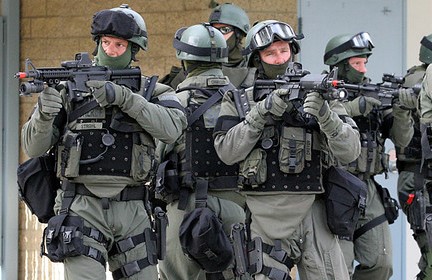
A masked officer is a frightening thing. When you cannot see the face of the person putting hands on you, you cannot identify him later, you cannot report him by name, and he knows it. That anonymity is the enemy of accountability, which is the whole reason it exists. California passed a law to stop it, the courts have been carving that law up ever since, and I want to give you a straight account of where things actually stand as of July 2026, because there is a lot of noise out there.
A note on timing: the litigation described below is moving quickly. The status here is current as of early July 2026. Because injunctions and new bills can change this picture, confirm the current state of the law before relying on it.
Can California police wear masks in 2026?
It depends on which officers. Under SB 627, the “No Secret Police Act,” it is generally a crime for local and out-of-state law enforcement to wear identity-concealing facial coverings on duty in California, with limited exceptions. A federal court has blocked enforcement of the mask ban against federal officers.
Governor Newsom signed SB 627 on September 20, 2025, and it took effect January 1, 2026. It added Penal Code § 185.5, which makes it a crime for a law enforcement officer to wear a facial covering that conceals or obscures their facial identity while performing their duties in California. The statute defines law enforcement officer to include peace officers employed by a city, county, or other local agency, officers from other states, and federal officers. It carves out narrow exceptions, including SWAT operations, authorized undercover work, tactical situations requiring protective gear, and medical masks.
Does the mask ban apply to ICE and federal agents?
As of July 2026, no, at least not enforceably. In February 2026 a federal judge issued a preliminary injunction barring California from enforcing SB 627’s mask ban against federal law enforcement officers, finding the law likely discriminates against the federal government. That ruling is why masked federal agents remain a live dispute.
This is where the headlines get confusing. In November 2025, the United States Department of Justice sued California to block the law. On February 9, 2026, U.S. District Judge Christina Snyder issued a preliminary injunction. She ruled that because SB 627 as written exempted California’s own state officers while reaching federal officers, it likely violated the intergovernmental immunity doctrine, a federal principle that bars states from discriminating against the federal government. In plain terms, the court said California cannot single out federal agents for a rule it does not also apply to its own state police.
Notably, the same judge rejected the federal government’s claim that masking is essential to officer safety, finding no cognizable justification for officers to conceal their identities. So the injunction rested on the discrimination problem, not on any blessing of masked policing.
That distinction is worth holding onto, because it points to where the law is heading. The Legislature has already moved to fix the discrimination flaw the court identified. A follow-up bill, SB 1004, was introduced to remove the state-officer exemption and apply the mask ban evenly to every officer in California, state, local, and federal alike. If a law like that passes and survives review, the intergovernmental immunity argument that sank the original version largely goes away, because the state would no longer be singling out federal agents. For now, though, the exemption in the enacted law is exactly the hook the courts used, and it is why enforcement against federal officers is frozen.
What is the difference between the mask ban and the officer identification law?
SB 627’s mask ban prohibits identity-concealing facial coverings. A separate measure, the officer identification requirement sometimes called the No Vigilantes Act, requires visible identification. Courts have treated them differently, and in April 2026 the Ninth Circuit enjoined enforcement of the identification requirement against federal officers pending appeal.
These are two different accountability tools, and they have fared differently in court. The identification requirement, which compels officers to visibly display identifying information, was initially upheld against the federal government by the district court. But the federal government appealed, and on April 22, 2026, the Ninth Circuit held that the identification law did directly regulate the federal government and was therefore likely unconstitutional as applied to federal officers, granting an injunction pending appeal. So as of now, enforcement of both the mask ban and the identification requirement against federal officers is on hold while the litigation continues.
Do California police agencies still have to post a mask policy?
Yes. Separate from the criminal ban, SB 627 requires every law enforcement agency operating in California to maintain and publicly post a written policy limiting facial coverings by July 1, 2026. A timely, compliant policy also shields the agency’s own officers from the criminal penalties.
This part of the law has not been enjoined, and it matters. Government Code § 7289 requires agencies to post a written facial-covering policy by July 1, 2026. That policy must affirm a commitment to transparency and public trust, state that generalized fear about officer safety is not enough to justify masking, require that sworn personnel not use facial coverings on duty, and list only narrowly tailored exemptions. If an agency posts a compliant policy on time, its officers are protected from the criminal penalties in Penal Code § 185.5. If it does not, the public, an oversight body, or a governing authority can challenge the deficiency.
For a person in Orange County or anywhere else in California, this posting requirement is more useful than it might sound. A department’s own written policy becomes a public yardstick. When an officer conceals his identity in a situation that does not fit any listed exemption, that policy is evidence that the department itself said this should not happen. In my work, a defendant’s own rules, violated by its own officer, are some of the most persuasive material a jury can see, because it takes the argument out of my mouth and puts it in theirs.
Why does a masked officer matter for a police misconduct case?
Anonymity blocks accountability. If you cannot identify the officer who used force against you, it is harder to file a complaint, harder to sue, and easier for the officer to avoid consequences. SB 627 also strips certain immunities from officers who commit torts while unlawfully masked, which can strengthen a civil claim.
From where I sit, this whole fight is about accountability, which is the thing the system works hardest to avoid. The reason I care about a mask is the same reason I care about a missing badge number or a switched-off body camera: it is one more way to make sure that when an officer crosses the line, no one can prove who did it. SB 627 recognized this by providing that an officer who commits certain torts, such as false arrest or false imprisonment, while wearing a facial covering in knowing violation of the statute, cannot assert privileges or immunities in a civil action and faces statutory damages. Where that provision applies, an unlawful mask is not just a policy violation; it is a thumb on the scale for the victim.
If you were detained, searched, or hurt by an officer whose identity was concealed anywhere in Southern California, do not assume the anonymity is the end of the road. There are ways to identify officers and agencies, and the law is increasingly on the side of transparency. You can learn more about how I approach these cases on my civil rights page and my Newport Beach police misconduct page. And keep in mind that this area of law is changing month to month, so the specifics above should be confirmed against the current state of the litigation.
About the Author
Jerry L. Steering has been suing police officers and defending bogus “Resistance Offense” criminal cases throughout California since 1984. A graduate of the University of Georgia School of Law (1984), he is admitted to practice in California, Georgia, the Ninth and Eleventh Circuits, and the United States Supreme Court. His police-misconduct cases have produced settlements and verdicts in the millions, and his work has been featured on ABC News, CNN, Good Morning America, Dateline NBC, The Washington Post, and the Los Angeles Times. He practices from Newport Beach and serves clients across Southern California.
Sources
- California Senate Bill 627 (2025), “Law enforcement: masks,” text and provisions, California Legislative Information: https://leginfo.legislature.ca.gov/faces/billTextClient.xhtml?bill_id=202520260SB627
- “California cannot enforce mask ban for federal agents, judge says,” NBC Los Angeles (Feb. 2026): https://www.nbclosangeles.com/news/local/california-immigration-agents-masks/3844287/
- “After US Judge Blocks California’s ICE Mask Ban…,” KQED (Feb. 2026): https://www.kqed.org/news/12072927/after-us-judge-blocks-californias-ice-mask-ban-scott-wiener-says-he-will-make-it-enforceable
- “Can States Prohibit Federal Law Enforcement from Masking on the Job?” State Democracy Research Initiative, Univ. of Wisconsin Law School (May 2026), on the Feb. 9 injunction and the April 22, 2026 Ninth Circuit injunction pending appeal: https://statedemocracy.law.wisc.edu/our-work/can-states-prohibit-federal-law-enforcement-from-masking-on-the-job
- “Face to Face with SB 627,” Liebert Cassidy Whitmore (agency policy and July 1, 2026 posting requirement): https://www.lcwlegal.com/news/face-to-face-with-sb-627/
- “California lawmakers push universal police mask ban… (SB 1004),” FOX 11 Los Angeles (Apr. 2026): https://www.foxla.com/news/california-universal-police-mask-ban-legislation-2026
Disclaimer: This article is for general informational purposes only and does not constitute legal advice. Reading this post or contacting Steering Law through this website does not create an attorney-client relationship. Every case is different; if you are facing a legal issue, you should consult a qualified California attorney about your specific situation. Past results do not guarantee similar outcomes.

Steering Law is a California-based civil rights and criminal defense firm led by Jerry L. Steering, Esq. The firm focuses on police misconduct cases, including excessive force, false arrest, malicious prosecution, contempt of cop incidents, and 42 U.S.C. §1983 civil rights actions, while also handling serious criminal defense matters. Steering Law is dedicated to protecting clients’ constitutional rights and delivering justice for individuals who have been wronged by law enforcement.
