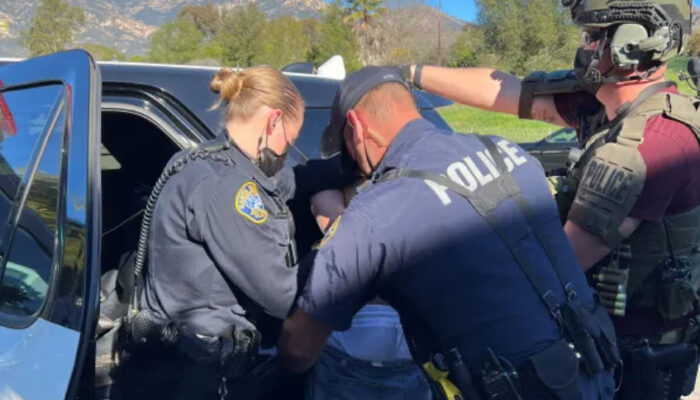
California police officers are not always legally required to provide their name or badge number on demand, but visible identification is important for accountability, and if an officer refuses to identify themselves or conceals their identity, citizens should calmly document the encounter, preserve evidence, and seek legal assistance to protect their rights.
Keypoints:
- California police officers are not always legally required to provide their name or badge number during every interaction with the public.
- If an officer refuses to identify themselves, citizens should calmly document the encounter and gather evidence instead of arguing.
- Recording police officers performing their duties in public is generally protected under the First Amendment.
- Senate Bill 627 aims to restrict law enforcement officers from concealing their faces while on duty, though the law is currently being challenged in court.
- Anonymous or masked officers can make it more difficult to hold law enforcement accountable for misconduct.
- Important details such as patrol car numbers, timestamps, locations, and witness information can help identify officers later.
- Civil rights attorneys can use legal tools such as subpoenas and records requests to uncover the identities of officers involved in alleged misconduct.
Do California police officers have to identify themselves?
It depends on the situation. California has no single statute requiring every officer to give a name and badge number on demand in all circumstances, but many department policies require it, and uniformed officers are generally expected to display visible identification. When an officer refuses to identify themselves, especially during a use of force or an arrest, it is a red flag, and it matters in a later case.
I have been doing this since 1984, and an officer who will not give you a name is often an officer who expects to do something he does not want traced back to him. A badge number is not a courtesy. It is accountability. When it goes missing, that is rarely an accident, and a jury can be told exactly why an officer might want to be anonymous in the moment he is putting his hands on someone.
What should you do if an officer won’t give a name or badge number?
Ask once, calmly, and then stop. Note the patrol car number, the location, the date, and the time. Look for body-worn cameras and other officers who can be identified. Find witnesses and preserve any video. Then call a civil rights attorney, who can use records requests and litigation to compel the agency to disclose who was involved.
Arguing about it on the street is not worth a “resistance offense” charge under Penal Code § 148(a)(1). The practical reality is that you do not need the officer to cooperate on the street in order to identify him later. I have identified plenty of officers who believed they were anonymous, through dispatch logs, shift and scheduling records, body-camera metadata, radio traffic, and the agency’s own paper trail. The badge can be hidden in the moment. It cannot be hidden in a lawsuit, where the agency is compelled to answer. So do not let a refusal to identify discourage you, and do not let it provoke you into conduct that hands them a charge.
Can California police wear masks while on duty?
This is changing, and it is not yet settled. In 2025 the Legislature passed Senate Bill 627, the “No Secret Police Act,” which restricts officers from concealing their faces while performing their duties and requires agencies to post a written facial-covering policy. As of this writing the law is being challenged in court, so its final shape is uncertain. Check the current status before relying on it.
Here is the background, because it explains why this became a fight. As reported, SB 627 prohibits federal and local law enforcement officers from wearing face masks while conducting their duties, and requires any law enforcement agency operating in California to maintain and publicly post a written policy limiting facial coverings by July 1, 2026. (LAAPOA) The same reporting notes that the Trump administration sued to block the law and that police unions opposed it. So this is genuinely in motion, and I am not going to tell you it is settled when it is not. When the courts resolve it, I will update this page.
Why does a masked, anonymous officer matter to your case? Because identification is the spine of accountability. If you cannot name the officer who hurt you, you cannot easily sue the officer who hurt you. The entire “officer’s safety” vocabulary the system leans on has a way of expanding into anonymity, and anonymity is precisely where misconduct hides. A law that forces officers to show their faces is not anti-police. It is pro-accountability, which only threatens the officers who have something to hide.
Can you record an officer who refuses to identify themselves?
Yes. In California and across the Ninth Circuit, you have a clearly established First Amendment right to record police performing their duties in public. Recording an officer who will not give a name is often the single most valuable thing you can do, because the video preserves the encounter, the patrol car, and the officer’s face even when the badge is hidden.
I tell people this constantly: the camera in your pocket is a better witness than your memory will ever be. Officers who refuse to identify themselves are counting on the absence of a record. A clear video defeats that. It captures the time, the place, the number of officers, the vehicle, and the conduct, and it does so in a form a jury can watch for itself. Keep a reasonable distance, do not interfere, and let the recording run. The right to record is settled law, and the agencies know it, which is part of why some officers are so hostile to the lens.
A word of caution that I give every client. The street is not the place to win the argument about identification. If you are being arrested, do not physically resist, because that hands the prosecutor a “resistance offense” charge that can be used to muddy your later civil claim. Comply, record what you can, stay calm, and fight the unlawful conduct later, in a forum where the agency has to answer under oath. That is where the badge comes off the anonymous officer.
How does anonymity affect a civil rights lawsuit?
Anonymity makes a case harder at the start but rarely fatal. Identifying the right officer is a threshold step in any § 1983 or state-law claim, and agencies sometimes resist it. But the tools of litigation, including records requests, subpoenas, and depositions, are built to pierce that wall, and a seasoned civil rights attorney expects the fight.
The lesson for you on the street is simple. Preserve every scrap of identifying information you safely can, because the more you gather in the moment, the faster your lawyer can put a name to the conduct. Patrol car numbers, the time and place, the number of officers, the direction they came from, and any video are all threads that lead back to a name. I have built entire cases out of exactly those threads.
If an officer refused to identify himself, or was concealing his identity, when he violated your rights in Orange County, including Irvine and the surrounding cities, or anywhere in Southern California, talk to someone who has spent decades forcing these agencies to put names to conduct.
FAQs
There is no single statute requiring it in every circumstance, but most department policies require visible identification, and a refusal to identify during an arrest or use of force is treated as a meaningful red flag in a later civil rights case.
Senate Bill 627, the “No Secret Police Act,” generally bans facial coverings that conceal an officer’s identity, but enforcement against federal officers is currently paused by a federal court while the law is challenged, so the practical answer depends on ongoing litigation.
Ask once calmly, do not escalate or physically resist, and instead preserve the patrol car number, location, time, and any video, since a civil rights attorney can later use records requests and litigation to identify the officer.
Yes, California and Ninth Circuit law clearly protect the right to record on-duty police in public, and that footage often becomes the most valuable evidence when an officer’s identity is otherwise concealed.
No, anonymity makes the case harder at the outset but is rarely fatal, since tools like records requests, subpoenas, and depositions are specifically designed to identify the responsible officer during litigation.

Steering Law is a California-based civil rights and criminal defense firm led by Jerry L. Steering, Esq. The firm focuses on police misconduct cases, including excessive force, false arrest, malicious prosecution, contempt of cop incidents, and 42 U.S.C. §1983 civil rights actions, while also handling serious criminal defense matters. Steering Law is dedicated to protecting clients’ constitutional rights and delivering justice for individuals who have been wronged by law enforcement.
