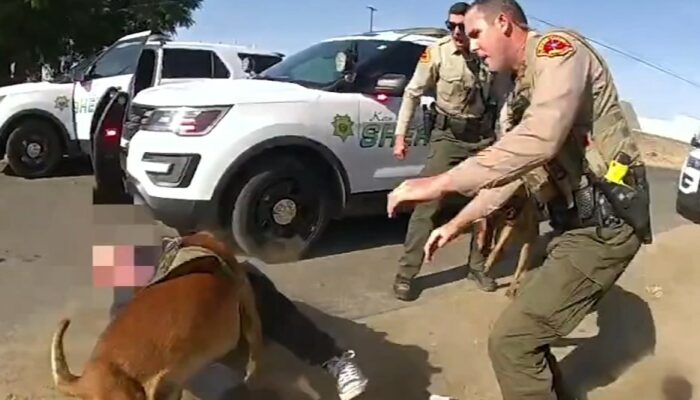
A police K-9 is not a passive tool. It is a weapon — powerful, unpredictable, and often devastating — that courts recognize as among the most severe uses of force available to law enforcement short of a firearm. Police dogs fall squarely within this framework.
When that weapon is deployed without justification, against someone who has surrendered, against an innocent bystander, or for longer than the situation requires, it is a Fourth Amendment violation, and it is something you can sue for. However, the Courts and the public are very indulgent to police officers using K-9s on civilians, and in recent years, the police need not make much of a showing to “justify” the police use of a K-9 on a civilian.
Police Dogs Are a Use of Force — And the Law Treats Them That Way
Ever since 1989, the U.S. Supreme Court have analyzed the use of force by the police as a Fourth Amendment violation under Graham v. Connor, 490 U.S. 386 (1989).
Under Graham v. Connor, all uses of force by police — deadly or not — must be objectively reasonable under the circumstances. The Supreme Court established a multi-factor balancing test applied to every excessive force claim:
The Ninth Circuit Court of Appeals Model Civil Jury Instruction for Excessive Force shows the following factors for the jury to consider. 9.27 Particular Rights—Fourth Amendment—Unreasonable Seizure of Person—Excessive Force:
(1) the nature of the crime or other circumstances known to the officer[s] at the time force was applied;
(2) whether the [plaintiff] [decedent] posed an immediate threat to the safety of the officer[s] or to others;
[(3) whether the plaintiff was actively resisting arrest or attempting to evade arrest by flight];
(4) the amount of time the officer[s] had to determine the type and amount of force that reasonably appeared necessary, and any changing circumstances during that period;
(5) the relationship between the need for the use of force and the amount of force used;
(6) the extent of the [plaintiff’s] [decedent’s] injury;
(7) any effort made by the officer[s] to temper or to limit the amount of force;
(8) the severity of the security problem at issue;
[(9) the availability of alternative methods [to take the plaintiff into custody] [to subdue the plaintiff;]]
[(10) the number of lives at risk (motorists, pedestrians, police officers) and the parties’ relative culpability; i.e.,which party created the dangerous situation, and which party is more innocent;]
[(11) whether it was practical for the officer[s] to give warning of the imminent use of force, and whether such warning was given;]
[(12) whether the officer[s] [was] [were] responding to a domestic violence disturbance;]
[(13) whether it should have been apparent to the officer[s] that the person [he] [she] [other pronoun] used force against was emotionally disturbed;]
[(14) whether a reasonable officer would have or should have accurately perceived a mistaken fact;]
[(15) whether there was probable cause for a reasonable officer to believe that the suspect had committed a crime involving the infliction or threatened infliction of serious physical harm; and]
Police dogs fall squarely within this framework. The Ninth Circuit Court of Appeals has consistently recognized K-9 deployment as a significant use of force — ranging from severe to intermediate depending on when the dog was released, how long the bite continued, whether the suspect had surrendered, and whether the handler maintained appropriate command.
This matters because a K-9 bite is not comparable to other intermediate force tools. A trained police dog bites with enough pressure to puncture light sheet metal, causing torn muscles, nerve damage, bone fractures, severe lacerations, permanent scarring, and in some cases death. The injuries K-9s inflict are frequently more severe than those caused by a baton, pepper spray, or Taser — making the threshold for justified deployment correspondingly higher.
When a K-9 Deployment Becomes Excessive Force
The deployment of a police dog is not automatically excessive force. Police have the authority to use K-9 units to locate concealed suspects, track individuals who have fled, and assist in the apprehension of people who pose a genuine danger. Courts have upheld K-9 deployments in cases involving dangerous felony suspects who were actively hiding and who had not surrendered.
The constitutional violations in K-9 cases typically arise in one of five ways:
1. Deployment against a suspect who has surrendered or poses no threat. The most clearly established rule in K-9 civil rights law: an officer cannot release a dog on a suspect who has fully surrendered and is under control. The Ninth Circuit stated it plainly in Watkins v. City of Oakland, 145 F.3d 1087 (9th Cir. 1998): “No particularized case law is necessary for a deputy to know that excessive force has been used when a deputy sics a canine on a handcuffed arrestee who has fully surrendered and is completely under control.” Officers who violate this rule cannot hide behind qualified immunity.
2. Prolonged biting after surrender. Even if the initial deployment was justified, the bite must stop once the suspect is no longer a threat. In Rosenbaum v. City of San Jose, 107 F.4th 919 (9th Cir. 2024), the Ninth Circuit held that permitting a police dog to hold a bite for 20 seconds after full surrender and officer control presented a triable jury question. A handler who allows biting to continue — or encourages the dog to rebite — after compliance has been achieved has committed an unconstitutional act. Unlike a baton strike, a K-9 attack continues independently of the suspect’s compliance until the handler commands release. That gap between surrender and release is where many of the worst violations occur.
3. Deployment against unarmed individuals for minor offenses. The Graham factors require courts to weigh the severity of the crime. Releasing a police dog on someone suspected of a non-violent misdemeanor — shoplifting, a traffic violation, trespassing — rarely withstands constitutional scrutiny. The ACLU reviewed 37 California police agencies and found that only San Jose’s policy limited K-9 deployment to situations involving a threat of serious injury. Many agencies permit deployment in circumstances where the force is grossly disproportionate to the offense.
4. Deployment against innocent bystanders. Police dogs occasionally injure people who were not the target — bystanders, family members, people in the wrong place. In those cases, the governmental interest that might otherwise justify force is entirely absent, and the constitutional violation is particularly clear.
5. Failures of training and department policy. When a department’s K-9 policy permits deployment in constitutionally unreasonable circumstances — or when the department fails to adequately train handlers — the department itself may face liability under the Monell doctrine. This avenue matters in cases where the individual officer’s conduct, while clearly wrong, might otherwise be shielded by qualified immunity.
California’s Legal Framework for K-9 Attack Cases
K-9 attack cases in California can be pursued on multiple legal tracks.
Federal civil rights claims under 42 U.S.C. § 1983 are the primary vehicle for constitutional excessive force claims against the individual officer and agency. Where the right violated was clearly established — as it is in cases involving biting a surrendered suspect — qualified immunity is unavailable.
California Bane Act claims (Civil Code § 52.1) add the no-qualified-immunity standard effective since SB 2 in 2022, treble damages, and enhanced attorney’s fees. For K-9 cases involving severe injuries, these multipliers can be decisive.
California’s dog bite statute (Civil Code § 3342) imposes strict liability on dog owners when their dog bites someone in a public place. It includes a law enforcement exemption for dogs used in apprehension or investigation — but that exemption does not apply when the dog attacked an innocent bystander or the department lacked a properly written K-9 use policy. Even where the exemption applies, the constitutional excessive force claim under § 1983 and the Bane Act remains fully available.
What K-9 Attack Cases Have Produced in California
California courts and agencies have paid significant sums to resolve K-9 attack cases. San Jose agreed to a $1.6 million settlement after a police dog attacked a man already on the ground, biting him in the throat. A San Mateo County case produced a $1.1 million jury verdict. Vallejo settled a case in which a police dog bit a driver through his car window for 23 seconds during a pursuit. These outcomes reflect both the severity of K-9 injuries and the legal vulnerability of agencies whose policies and training do not meet constitutional standards.
No national database tracks police K-9 deployments or injuries — which itself tells part of the story. Without systematic data, patterns of unconstitutional use go undetected, and accountability arrives only when individual victims pursue civil rights claims. That makes the decision to sue consequential not just for the victim but for everyone in communities where these dogs are deployed.
Frequently Asked Questions About Police K-9 Attack Cases
Yes. The lawfulness of an arrest is separate from the lawfulness of the force used to make it. An officer can have probable cause to arrest you and still deploy a K-9 in a constitutionally unreasonable manner. The question is not whether the arrest was justified but whether the specific use of the dog — when released, how long the bite lasted, whether the situation warranted it — was objectively reasonable under the Graham factors.
This is one of the most well-established excessive force scenarios in K-9 civil rights law. The Ninth Circuit has held that excessive bite duration is itself a constitutional violation, and that a handler who permits biting to continue after surrender cannot hide behind qualified immunity. Document everything — your words, your physical actions, the moment you surrendered, how long the bite continued.
Warnings are a factor, not a shield. An officer can give proper warnings and still commit excessive force if the deployment itself was unjustified given the circumstances. Warnings are not a checkbox that legalizes whatever follows. A dog released against an unarmed, compliant person after proper warnings is still an unconstitutional use of force.
If you were injured by a police K-9 during an enforcement operation you were not involved in, you may have the strongest case of all. The governmental interest that might justify deploying a dog on a fleeing suspect does not apply to you. Depending on the facts, California’s dog bite statute may also apply without the law enforcement exemption, creating an additional avenue for recovery.
The same as all California police misconduct cases: you must file a government tort claim with the responsible agency within six months of the incident before pursuing California state law claims, and the federal § 1983 statute of limitations is two years. As covered in Blog #3, missing the six-month government claim deadline permanently destroys your state law claims. Call an attorney immediately after the incident.
K-9 Injuries Are Serious. The Legal Fight Is Real. Do Not Face It Alone.
A police dog attack can require surgery, leave permanent scarring, cause lasting nerve damage, and generate psychological trauma that outlasts the physical wounds by years. The legal case that follows is not simple. K-9 excessive force cases require careful analysis of the Graham factors, the department’s written K-9 policy, the officer’s training record, the handler’s commands during the encounter, and the body camera footage that captures what the police report often omits.
The Law Offices of Jerry L. Steering has handled canine mauling cases in Southern California as part of a civil rights practice that has been holding police accountable since 1984. We know this area of law, we know where violations most commonly occur, and we know how to build the case that gives you the best chance at justice.
| Call Jerry L. Steering, (949) 474-1849 — Available 24 Hours a Day Free Case Evaluation — No Fee Unless We Recover jerry@steeringlaw.com | steeringlaw.com/free-case-evaluation Law Offices of Jerry L. Steering | Newport Beach, California Serving Orange County, Los Angeles County, Riverside County, San Diego County, and throughout California |
Prior case results do not guarantee or predict similar outcomes in future matters. This article is for informational purposes only and does not constitute legal advice. The State Bar of California does not recognize a specialty in police misconduct.
Sources
- Graham v. Connor, 490 U.S. 386 (1989) — U.S. Supreme Court establishing objective reasonableness standard for all Fourth Amendment excessive force claims. https://supreme.justia.com/cases/federal/us/490/386/
- Watkins v. City of Oakland, 145 F.3d 1087 (9th Cir. 1998) — Ninth Circuit holding that excessive bite duration is a constitutional violation; no particularized case law needed to establish that biting a handcuffed, surrendered suspect is unconstitutional.
- Chew v. Gates, 27 F.3d 1432 (9th Cir. 1994) — Ninth Circuit identifying two types of K-9 excessive force claims; reversing summary judgment on unreasonable dog bite.
- Rosenbaum v. City of San Jose, 107 F.4th 919 (9th Cir. 2024) — Ninth Circuit holding that permitting a police dog to hold a bite for 20 seconds after full surrender and officer control presents a triable jury question.
- Tennessee v. Garner, 471 U.S. 1 (1985) — Deadly force against a fleeing suspect who poses no danger is unconstitutional; foundational excessive force precedent.
- 42 U.S.C. § 1983 — Federal civil rights cause of action for constitutional violations under color of state law.
- California Civil Code § 52.1 — Tom Bane Civil Rights Act; no qualified immunity for Bane Act claims post-SB 2 (effective January 1, 2022).
- California Civil Code § 3342 — Dog bite strict liability statute; law enforcement exemption and its limits.
- Ninth Circuit Model Jury Instructions § 9.27 — Excessive force; K-9 deployment classified as severe to intermediate force depending on circumstances. https://www.ce9.uscourts.gov/jury-instructions/node/163
- ACLU — Policy brief on California K-9 use; analysis of 37 California police agency policies. Referenced in V&Z Law Firm analysis. https://www.vzlawfirm.com/after-numerous-excessive-force-lawsuits-will-california-limit-its-use-of-canine-units-during-police-encounters/
- Fund Capital America — “$1.6M San José K-9 Settlement,” July 2025. https://fundcapitalamerica.com/san-jose-pays-1-6m-in-k-9-dog-bite-settlement/
- Law360 — “Too Often, Use of K-9 Units Is Cruel and Unusual Punishment,” citing Koistra v. County of San Diego (S.D. Cal. 2018) — qualified immunity denied where officer allowed bite to continue 30+ seconds after clear surrender. https://www.law360.com/articles/1696645/too-often-use-of-k-9-units-is-cruel-and-unusual-punishment

Steering Law is a California-based civil rights and criminal defense firm led by Jerry L. Steering, Esq. The firm focuses on police misconduct cases, including excessive force, false arrest, malicious prosecution, contempt of cop incidents, and 42 U.S.C. §1983 civil rights actions, while also handling serious criminal defense matters. Steering Law is dedicated to protecting clients’ constitutional rights and delivering justice for individuals who have been wronged by law enforcement.
