
Why You (Usually) Can’t Plead and Sue: “Collateral Estoppel” and the “Heck Bar” for “Resistance Offenses in California”.
THE GAME IS RIGGED; CONVICTING THE INNOCENT IS AN ART FORM FOR CALIFORNIA PUBLIC PROSECUTORS.
The short answer to the question of whether you can plead guilty to a resistance offense and thereafter sue the police for false arrest, or for excessive force, is “No” for a false arrest case, and usually “No” for an excessive force case.
 Police Officers are trained from day one at the Police Academy that if their beating/false arrest victims are convicted of resistance offenses such as “resisting arrest“, “resisting arrest with threat or use of force or violence“, “battery on a police officer” and “assault on a peace officer“, that they are thereafter precluded from suing the police. That proposition is usually accurate.
For example, persons convicted of “resistance offenses” are generally precluded from suing the police officers who beat them or falsely arrested them, or otherwise violated their constitutional rights., via the doctrine of “collateral estoppel“, or via cases such as Heck v. Humphrey, 512 U.S. 477 (1994).
“Collateral estoppel” precludes a party from relitigating an issue that has been determined against them in a prior judicial or administrative proceeding. All California “resistance offenses” are require that the alleged “victim police officers” be lawfully engaged in the performance of their duties. So, for example, a California peace officer who is using excessive force, or is unlawfully detaining or arresting another is not, by definition, engaged in the lawfully performance of his/her duties, as a peace officer has no duty to use excessive force, or unlawfully detain or arrest another.
Therefore, if one is convicted of a California “resistant offense” such as such as violation of Cal. Penal Code § 69 (resisting officer with force), Cal. Penal Code § 148(a)(1) (resisting / delaying / obstructing an officer), Cal. Penal Code § 240/241 (assault on officer), Cal. Penal Code § 242 / 243(b) & (c) (battery on an officer causing injury) and Cal. Penal Code § 245(c) (assault on officer with weapon), there has been a judicial determination that the officers were not using excessive force, or is unlawfully detaining or arresting another.
Therefore, via the doctrine of “collateral estoppel“, the person convicted of any such “resistance offense” is now precluded from suing the police for using excessive force, or is unlawfully detaining or arresting them.
Moreover, as a policy matter, the U.S. Supreme Court has taken it upon themselves to preclude one for suing for a false arrest if one is convicted of any crime, notwithstanding any lack of a warrant or probable cause to believe that one committed a crime at the time of the arrest; the actual material inquiry in a false arrest case. See, Heck v. Humphrey, 512 U.S. 477 (1994).
This article explains why one who pleads guilty to a “resistance offense” usually cannot thereafter sue the police.
WHY JOHNNY OR SUZY CAN’T PLEAD AND SUE; COLLATERAL ESTOPPEL AND THE HECK BAR.
 California Peace Officers (police officers, deputy sheriffs and various other law enforcement officers from California state and local agencies) are trained from day one at the Police Academy that if their beating victims, or false arrest victims, or even shooting victims, are convicted of a “resistance offense”, that they are either entirely or mostly precluded from suing the violating Peace Officers in a civil case.
If the police beat you, it’s a given that they are going to arrest you and claim that you committed some “resistance offense”. After all, how would it look if they just beat you, but did not claim that you committed a crime that necessitated their doing so?
Accordingly, in the real world, when the police unlawfully and unjustifiably beat you or tase you or pepper-spray you, or sic their police dog on you, or even shoot you, they are going to have to justify their doing so by at least attempting to frame you (procure your malicious criminal prosecution) for some fabricated “resistance offense”.
DON’T LOOK TO YOUR LOCAL COUNTY DISTRICT ATTORNEY TO PROTECT YOU FROM THE POLICE.
 Your local County District Attorney’s Office usually believes that rather seeking the truth and doing justice, that they need to protect the police from a lawsuit by you, by convicting you of one of these various “resistance offenses”. The worse the police beating, the more serious criminal charges will be filed against you, by the police and by your local County District Attorney’s Office.
Moreover, these days, many of the California County District Attorney’s Office have prosecution units called “CAPO” Units; “Crimes Against Peace Officers” Units. In truth, they should be more properly called “Crimes BY Peace Officers” Units. CAPO Units are those Units whose actual real-world mission is to protect California peace officers who unlawfully use excessive force and who falsely arrest innocents, by prosecuting innocent civilian victims for “resistance offenses”.
Young local County Deputy District Attorneys in those “CAPO” Units are usually trying to “get in” with various police agencies, and to score brownie points with their employing District Attorney’s Office to get promoted. Convicting innocent victims of police beatings and false arrests is the best way to “get in” with the police.
Many of them want to be a Judge someday, and California Superior Court Judges are prohibited from politically campaigning. They are restricted to announcing their candidacy, raising campaign funds through committees, distributing campaign materials, and speaking about their qualifications and judicial philosophy within ethical boundaries. However, what Judicial candidates really treasures are endorsements by police agencies. This is why “getting in” with various county police agencies matters. To someday get their endorsements when running for Superior Court Judge, or for reelection as a Superior Court Judge. This is not lefty propaganda. This is reality.
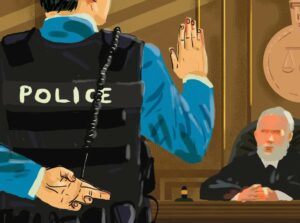 Moreover, in the real world, as a practical matter, there really is no such thing as perjury (Cal. Penal Code § 118). With very few exceptions, the only people who get criminally prosecuted for perjury in a California Superior Court are politicians, welfare recipients and DMW applicants. If your local District Attorney’s Office prosecuted everyone who they could prove beyond a reasonable doubt committed perjury, California would have to triple the number of California state prisons to house all of the convicted perjurers.
Perjury is so rampant in California, that the Superior Court Judges have an unwritten “rule” called the “three-lie rule”. That rule provides that if a criminal defendant takes the witness stand in his/her own defense at trial, if they don’t tell any more than three lies, that the judge should not hold their lying against them in sentencing them if they are convicted.
More often than not, your local County District Attorney cares more about being reelected than they care about convicting innocent people to protect the police. After all, no one ever got elected District Attorney in this country by promising to protect the public from the police.
Accordingly, these young ambitious Deputy District Attorney’s suborn and choreograph perjured testimony from the very peace officers who violated your constitutional rights, to convict the innocent of some fabricated “resistance offense”. After all, who is going to prosecute the police for lying on the witness stand? The lying officer’s employing police agency who put him up to lying to protect their employing public entity? The very County District Attorney’s Office who knowingly elicited the perjured testimony to convict the innocent “resistance offense” defendant. The California Attorney General’s Office? The Pope? Not a chance.
As the saying goes among District Attorneys and their Deputy District Attorney, “It’s easy to convict the guilty, but it takes great skill to convict the innocent.”
CALIFORNIA “RESISTANCE OFFENSES”.
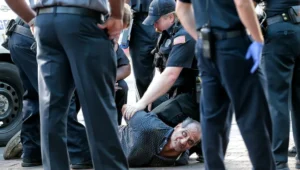 The most commonly used (and commonly fabricated) California “Resistance Offenses” include “Resisting Arrest” (misdemeanor resisting/delaying/obstructing peace officer, Cal. Penal Code § 148(a)(1)), “Resisting Officer with threat or use of force or violence” (Cal. Penal Code § 69, a wobbler offense that can be charged as either a misdemeanor or a felony), “Assault on Peace Officer” (a misdemeanor Cal. Penal Code § 240/241), “Battery on Peace Officer” (a misdemeanor, Cal. Penal Code § 242 / 243(b)), “Battery on Peace Officer Causing Injury” (a felony, Cal. Penal Code § 243(c)(2)) and “Assault on Peace Officer With Weapon or By Means Likely to Result in Great Bodily Injury” (a felony, Cal. Penal Code § 245(c)) (assault on officer with weapon).
For many years California Peace Officers routinely arrested and procured the malicious criminal prosecution of their innocent victims for violation of misdemeanor “Resisting Arrest” (misdemeanor resisting / delaying / obstructing peace officer Cal. Penal Code § 148(a)). The “joke” among California peace officers used to be that they should arrest an innocent for violation of misdemeanor “resisting arrest”, Cal. Penal Code § 148(a), when he/she has not committed a crime but “just needs to go to jail anyway”.
WHAT IS A LAWFUL ORDER THAT ONE CAN BE ARRESTED AND PROSECUTED FOR FAILING TO OBEY?
The police often justify, or at least attempt to justify, these arrests for violation of Cal. Penal Code § 148(a) on the ground that an innocent person failed to follow a “lawful order” of a peace officer“, and that by failing to follow such a “lawful order“, that the legally innocent person “resisted” or “delayed” or “obstructed” the officer in the performance of their duties. However, neither the California Penal Code nor any other statutory source defines what a “lawful order”.
These “lawful orders” are only “lawful” or “unlawful” in the eyes of the Courts, and, ultimately, the, the juries who decide whether one is guilty or not of some, usually fabricated, “resistance offense”.
 In criminal cases, the jury is supposed to be the Trier of Fact, and the Court is supposed to be the Trier of Law. However, in cases where one is accused of “failing to obey a lawful order”, the jury becomes the Trier of Law as well as the Trier of Law. That is because in trials that involve the police and the prosecutor claiming that one has violated a resistance offense, the jury gets to determine what a lawful order is.
These days it has become commonplace for the police to order anyone who they have the slightest basis to detain, to sit down or prone oneself out on the ground, notwithstanding how unreasonable such an order may have been under the circumstances. Prior to 1987 the Courts used to hold that in order to order someone to get on the ground at gunpoint, an order needed to have probable cause to believe that one committed a serious dangerous felony, and, that they presented an immediate danger to the officer. See, United States v. Buffington, 815 F.2d 1292 (9th Cir. 1987).
Motorists often are told to exit their vehicles on traffic stops; again, notwithstanding how unreasonable such an order may have been under the circumstances. This is commonplace.
Police officer may also order civilians to turn around, or place their hands behind their back or to exit their residence, or to show them identification. However, in a “resistance offense” case, the jury is not instructed as to what a “lawful order” is.
The California Criminal Case Standard Jury Instructions are not very helpful in defining what a “lawful order” is. For example, the California Criminal Case Standard Jury Instruction on “resisting arrest”, CALCRIM 2656, provides in pertinent part:
The defendant is charged in Count 1 with resisting, or, obstructing, or delaying a peace officer in the performance or attempted performance of his/her duties in violation of Penal Code section 148(a)].
To prove that the defendant is guilty of this crime, the People must prove that:
1. [Name of Peace Officer] was a peace officer lawfully performing or attempting to perform his/her duties as a peace officer;
2. The defendant willfully resisted, or obstructed, or delayed [Name of Peace Officer] in the performance or attempted performance of those duties;
AND
3. When the defendant acted, he/she knew, or reasonably should have known, that [Name of Peace Officer] was a peace officer performing or attempting to perform his/her duties.
The sentence, “1. [Name of Peace Officer] was a peace officer lawfully performing or attempting to perform his/her duties as a peace officer” is the key phrase in why a resistance offense usually prevents you from suing the police if you are convicted of “resisting arrest”.
For example, persons convicted of “resistance offenses” are generally precluded from suing the police officers who beat them or falsely arrested them, or otherwise violated their constitutional rights, via the doctrine of “collateral estoppel“, or via cases such as Heck v. Humphrey, 512 U.S. 477 (1994).
THE DOCTRINE OF COLLATERAL ESTOPPEL.
“Collateral estoppel” precludes a party from relitigating an issue that has been determined against them in a prior judicial or administrative proceeding. All California “resistance offenses” are require that the alleged “victim police officers” be lawfully engaged in the performance of their duties. So, for example, a California peace officer who is using excessive force, or is unlawfully detaining or arresting another is not, by definition, engaged in the lawfully performance of his/her duties, as a peace officer has no duty to use excessive force, or unlawfully detain or arrest another.
 Therefore, if one is convicted of a California “resistant offense” such as such as violation of Cal. Penal Code § 69 (resisting officer with force), Cal. Penal Code § 148(a)(1) (resisting / delaying / obstructing an officer), Cal. Penal Code § 240/241 (assault on officer), Cal. Penal Code § 242 / 243(b) & (c) (battery on an officer causing injury) and Cal. Penal Code § 245(c) (assault on officer with weapon), there has been a judicial determination that the officers were not using excessive force, or is unlawfully detaining or arresting another.
Therefore, via the doctrine of “collateral estoppel“, the person convicted of any such “resistance offense” is now precluded from suing the police for using excessive force, or is unlawfully detaining or arresting them.
THE “HECK BAR” IS A POLICY DECISION OF THE SUPREME COURT TO PROTECT THE POLICE.
Contrary to popular belief in America, it is not a false arrest for a police officer to arrest a totally innocent person. It is only a false arrest if the arresting police officer did not arrest the person pursuant to a warrant for their arrest, or if the officer had “probable cause” to believe that the arrested person committed a crime.
“Probable Cause” is defined as “a strong suspicion of guilt”, or a “a reasonable belief by a reasonably well-trained police officer that a crime has been committed, and that the person arrested probably committed it”.
Once probable cause has been established the arresting police officer is under no obligation to further investigate the matter, and may then lawfully effect the arrest.
However, the propriety of the arrest is determined at the time of the arrest; not at some time in the future. Notwithstanding that requirement, the U.S. Supreme Court has taken it upon themselves to preclude one for suing for a false arrest if one is convicted of any crime, notwithstanding any lack of a warrant or probable cause to believe that one committed a crime at the time of the arrest. See, Heck v. Humphrey, 512 U.S. 477 (1994). This is simply the Supreme Court protecting the police; nothing more.
FALSE ARRESTS AND THE RISE OF THE POLICE STATE IN AMERICA; ATWATER V. CITY OF LAGO VISTA.
If a police officer arrests you for any violation of law, even a parking ticket or a seat-belt violation, actually taking you to jail and booking you does not violate the Fourth Amendment; at least since 2001. See, Atwater v. City of Lago Vista, 532 U.S. 318 (2001) (arrest for violation of Texas seat-belt statute that carries a maximum $50.00 fine and no jail, not violative of the Fourth Amendment’s prohibition against “unreasonable searches and seizures”.)
Atwater v. City of Lago Vista is a terrible decision by the Supreme Court; so terrible that the majority of arrests cases deal with traffic stops, and even the most de minimis traffic infraction will justify an arrest, even if the police did not have probable cause to have arrested the motorist for the crime that they were actually arrest for.
Atwater v. City of Lago Vista is a such a terrible decision, that Conservative Republican Associate United States Supreme Court Justice Sandra Day O’Connor wrote a stinging in Atwater, warning of the potential for abuse by the police:
 “Such unbounded discretion [to arrest for even the most trivial offense] carries with it grave potential for abuse. The majority takes comfort in the lack of evidence of an epidemic of unnecessary minor-offense arrests. Ante, at 33, and n. 25. But the relatively small number of published cases dealing with such arrests proves little and should provide little solace. Indeed, as the recent debate over racial profiling demonstrates all too clearly, a relatively minor traffic infraction may often serve as an excuse for stopping and harassing an individual.
After today, the arsenal available to any officer extends to a full arrest and the searches permissible concomitant to that arrest. An officers subjective motivations for making a traffic stop are not relevant considerations in determining the reasonableness of the stop. See Whren v. United States, supra, at 813. But it is precisely because these motivations are beyond our purview that we must vigilantly ensure that officers post stop actions which are properly within our reach comport with the Fourth Amendments guarantee of reasonableness . . . . The Court neglects the Fourth Amendments express command in the name of administrative ease. In so doing, it cloaks the pointless indignity that Gail Atwater suffered with the mantle of reasonableness. I respectfully dissent.” Atwater v. City of Lago Vista, 532 U.S. 318 (2001) O’Connor, J., Dissenting.
IF YOU ARE THE VICTIM OF POLICE MISCONDUCT, JERRY L. STEERING CAN HELP YOU ACTUALLY ENFORCE YOUR RIGHTS BY WINNING YOUR CASE.
 The only thing that matters when enforcing your rights, is whether you win your case. If you don’t win your case, then you have no rights because you have no way to enforce them.
Just because the police violated your constitutional rights doesn’t mean that you can do anything about it. In order to “do something about it”, to enforce your constitutional rights, it takes a great deal of experience, insights, skill and savvy. You need a unanimous jury of usually 8 jurors to vote in your favor in federal court to win your case. If you mouth-off to the cops or don’t do what the police tell you to do or cuss out the cops, or act like a jerk, one or more of the jurors in your case may not vote for you. That is the reality in which we all live.
Mr. Steering’s many years of experience and knowledge in suing the police can help you maximize your chances of winning your Police Misconduct Civil Rights case, and winning is the only thing that matters.
Jerry L. Steering has been suing police agencies for constitutional violations since 1984. He has the experience, insights, skill and savvy to actually win your police misconduct civil rights case, and winning is the only thing that matters. As the old saying goes, “The young lawyer knows the law, but the old lawyer knows the Judge”.
If you are the victim of police misconduct, Jerry L. Steering can help you. Call Jerry L. Steering, Esq. at (949) 474-1849, or email Mr. Steering at jerry@steeringlaw.com .
 FREE CASE EVALUATION