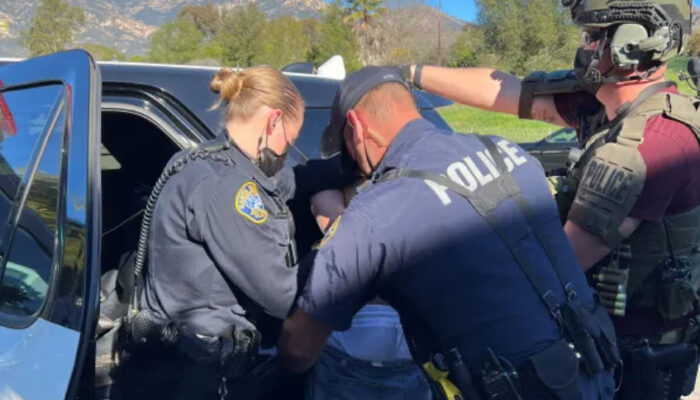
You asked a question. You refused to let an officer search your car. You pulled out your phone and started recording. You raised your voice and told the officer he had no right to be there.
None of those things are crimes in California. Every single one of them is constitutionally protected conduct.
And yet, here you are — handcuffed, charged with “resisting arrest,” trying to figure out how a situation where you did nothing wrong turned into a criminal case against you.
There is a name for what happened to you. Police officers call it an attitude problem. Civil rights attorneys call it what it actually is: Contempt of Cop.
What “Contempt of Cop” Actually Means
“Contempt of Cop” is not a charge. You will not find it in the California Penal Code. It is the street term — and the legally accurate description — for what happens when a police officer arrests someone not because they committed a crime, but because they questioned, challenged, or otherwise bruised the officer’s ego.
The trigger can be almost anything:
- Asking “Why am I being stopped?”
- Telling an officer you know your rights
- Refusing to consent to a warrantless search
- Recording the encounter on your phone
- Using language the officer does not like
- Simply failing to comply fast enough
The officer perceives each of these as a challenge to authority. And when that perception kicks in, the encounter stops being about law enforcement. It becomes about control. The officer’s next move is almost always the same: manufacture a legal pretext to take you into custody and shift the blame from their conduct to yours.
That pretext has a formal name too. It is called a “resistance offense.”
The Resistance Offense: How Cops Turn Your Rights Into a Crime
California gives police officers a remarkably broad legal tool for this purpose. California Penal Code § 148(a)(1) makes it a crime to willfully resist, delay, or obstruct a peace officer in the performance of their duties. In practice, that statute is so vague and expansive that it can be applied to almost anything.
Ask a question at the wrong moment? Obstruction. Move your arm while being handcuffed? Resistance. Take a step back? Delay.
When an officer decides to make a Contempt of Cop arrest, they write a police report characterizing your constitutionally protected conduct as one of these offenses. That report goes to the District Attorney’s office or the City Attorney’s office. Prosecutors file charges without questioning whether what you actually did qualifies as a crime under the law.
You are now a defendant. The officer who violated your rights is now a complaining witness. The system that is supposed to protect you is now pointed at you.
For more serious cases, the police do not stop at § 148(a)(1). They reach for California Penal Code § 69 — the felony version — which covers resisting an executive officer by force or threat. A § 69 charge carries potential state prison time and is designed to make you desperate enough to take a plea deal. Once you take that deal, you forfeit — permanently — your right to sue the officer who abused you.
That is not a coincidence. It is the system working exactly as designed.
Why a Plea Bargain Can Destroy Your Civil Rights Case
This is the part most people do not understand until it is too late.
If you are convicted of a resistance offense — whether by jury verdict or by accepting a plea bargain — you have almost certainly lost your ability to sue the police for what they did to you.
For a conviction under § 148(a)(1) to stand, a court must find that the officer was performing lawful duties during the encounter. That finding becomes a settled legal fact under the doctrine of collateral estoppel. You cannot re-litigate it in a civil rights lawsuit. You cannot go to federal court and argue the officer violated your Fourth Amendment rights if a criminal court has already determined the officer was acting within the law. The case is blocked before it begins. (Heck v. Humphrey, 512 U.S. 477 (1994).)
This is precisely why police routinely arrest their victims for resistance offenses. It is not sloppiness. It is a calculated legal strategy to insulate the officer from civil liability by converting you from a victim into a convicted defendant.
Taking a plea — even to a minor misdemeanor, even to get out of jail, even because you cannot afford to fight — can permanently close the door on justice.
What the Law Actually Protects
California and federal law are unambiguous on several points that Contempt of Cop arrests routinely violate:
- You have the right to verbally challenge a police officer. Offensive speech directed at a government official — including police — is constitutionally protected under the First Amendment. City of Houston v. Hill, 482 U.S. 451 (1987). Calling an officer names is not a crime. Yelling is not obstruction.
- You have the right to refuse consent to a search. The Fourth Amendment guarantees your right to be free from unreasonable searches and seizures. Exercising that right is not evidence of guilt and cannot legally form the basis for an arrest.
- You have the right to record police activity in public. This is a clearly established First Amendment right throughout the Ninth Circuit. Fordyce v. City of Seattle, 55 F.3d 436 (9th Cir. 1995). An officer who arrests you for recording them has violated your constitutional rights.
- An officer cannot lawfully arrest you for protected conduct. Because § 148(a)(1) requires that the officer be performing lawful duties, an officer who is violating your rights is not performing lawful duties. Under People v. Curtis, 70 Cal.2d 347 (1969), you cannot legally be convicted of resisting an officer who is acting unlawfully.
That last point is critical. The defense is built into the statute itself. But it takes an attorney who knows how to use it — and who understands that defending the criminal case and building the civil rights case must happen simultaneously.
Frequently Asked Questions About Contempt of Cop Arrests
The breadth of § 148(a)(1) is intentional. “Delay” under that statute can technically include almost any non-immediate compliance. Police exploit that vagueness to justify an arrest after the fact. Whether the charge survives legal scrutiny depends largely on whether the officer was acting lawfully in the first place and that question is exactly what a skilled civil rights attorney is trained to contest.
In most cases, no. A conviction — including one from a guilty plea — will bar a civil rights lawsuit arising from the same incident. There are narrow exceptions, but they are difficult to establish. This is the most important reason to consult a civil rights attorney before accepting any plea in a case involving alleged police misconduct.
It always is. Police are trained to write reports that justify their actions. That is why the first 24 to 72 hours after an incident matter so much. Surveillance footage, witness contact information, photographs of injuries, and medical records are all critical. The officer’s report is one account. The physical record is another.
No. Recording police in a public space is constitutionally protected throughout the Ninth Circuit. An arrest for recording police activity is itself a civil rights violation — grounds for a claim under 42 U.S.C. § 1983.
Ask yourself one question: Did the arrest happen because you committed a crime, or because the officer did not like what you said, what you did, or how quickly you complied? If the honest answer is the second one, call an attorney. The law may be on your side — but only if you fight.
What to Do If You Believe You Were a Contempt of Cop Victim
Do not take a plea deal without talking to a civil rights attorney first. That cannot be said plainly enough. The offer may seem appealing — especially if you are sitting in jail facing a misdemeanor and the prosecutor is telling you it will all go away. What they are not telling you is what goes away with it.
Do not speak to the police about the incident without an attorney present. Anything you say will be used to support the officer’s version of events, not yours.
Document everything you remember while it is still fresh — the exact words exchanged, the sequence of events, badge numbers if you caught them, any witnesses present.
Seek medical attention if you were injured and preserve those records.
Then call an attorney who has spent decades doing exactly this.
You Have Rights. Enforcing Them Is the Only Thing That Makes Them Real.
The Law Offices of Jerry L. Steering has been suing the police and defending bogus resistance offense charges since 1984 — longer than most civil rights attorneys have been practicing law. We understand that a Contempt of Cop case is two cases at once: the criminal defense case and the civil rights lawsuit. How the criminal case is handled determines whether the civil rights case can ever be brought. We handle both.
If you were arrested for questioning police conduct, asserting your rights, or simply failing someone’s attitude test, call us. The consultation is free. The call is confidential. And the sooner you make it, the more options you will have.
| Call Jerry L. Steering (949) 474-1849 — Available 24 Hours a Day Free Case Evaluation — No Fee Unless We Recover jerry@steeringlaw.com | steeringlaw.com/free-case-evaluation Law Offices of Jerry L. Steering | Newport Beach, California Serving Orange County, Los Angeles County, Riverside County, San Diego County, and throughout California |
The results of prior cases do not guarantee or predict similar results in future cases. This article is for informational purposes only and does not constitute legal advice. The State Bar of California does not recognize a specialty in police misconduct.
Sources
- California Penal Code § 148(a)(1) — Resisting, delaying, or obstructing a peace officer. California Legislative Information. https://leginfo.legislature.ca.gov
- California Penal Code § 69 — Resisting executive officer. California Legislative Information. https://leginfo.legislature.ca.gov
- People v. Curtis, 70 Cal.2d 347 (1969) — Officers acting unlawfully are not performing lawful duties; resistance offense requires lawful officer conduct.
- Heck v. Humphrey, 512 U.S. 477 (1994) — Conviction bars § 1983 civil rights claim arising from same conduct. United States Supreme Court.
- City of Houston v. Hill, 482 U.S. 451 (1987) — First Amendment protects verbal challenges to police officers. United States Supreme Court.
- Fordyce v. City of Seattle, 55 F.3d 436 (9th Cir. 1995) — First Amendment right to record police activity in public. Ninth Circuit Court of Appeals.
- California Judicial Council Criminal Jury Instructions (CALCRIM 2656, 2670) — Standard instructions for § 148(a)(1) and officer lawfulness. California Courts. https://www.courts.ca.gov
- Law Offices of Jerry L. Steering — “Contempt of Cop & Resisting Arrest Cases in California.” https://steeringlaw.com/criminal-defense/contempt-of-cop-resisting-arrest/
- Law Offices of Jerry L. Steering — “The Contempt of Cop Game: How Well Can You Play.” https://steeringlaw.com/police-misconduct-articles/the-contempt-of-cop-game-how-well-can-you-play/
- Law Offices of Jerry L. Steering — “Defending Bogus Resisting Arrest & Battery on Peace Officer Cases.” https://steeringlaw.com/defending-bogus-resisting-arrest-battery-on-peace-officer-cases/

Steering Law is a California-based civil rights and criminal defense firm led by Jerry L. Steering, Esq. The firm focuses on police misconduct cases, including excessive force, false arrest, malicious prosecution, contempt of cop incidents, and 42 U.S.C. §1983 civil rights actions, while also handling serious criminal defense matters. Steering Law is dedicated to protecting clients’ constitutional rights and delivering justice for individuals who have been wronged by law enforcement.
